Snapping Hip (also called Clicking Hip) is a relatively common problem among dancers.
Generally, snapping hip is characterized by a pop or cracking sound (not dissimilar to “cracking” the knuckles of the hand) as you move from hip flexion to extension – in other words, when going from a position with the knee bent and pulled up towards the torso to the knee extended down toward the other leg.
I first noticed that I had snapping hip when I was about 16 and tried my first Pilates class. Every time one or both legs were extended out a few inches from the floor (while lying on my back), I’d hear a pop in my hip joint. Snapping hip is often a result of a tight tendon rolling over protrusions of the femur or pelvis.
While it can be annoying and a little disconcerting to hear that popping sound, there is not necessarily any cause for alarm.
In an article by Joseph P Garry, MD, he points out that nearly half of the female ballet dancers seeking treatment for hip complaints were experiencing snapping hip, but only one third of those were experiencing pain. A 2008 article in Current Sports Medicine Reports found that about 10% of total dancers have snapping hip, and corroborated Dr. Garry’s figure of only 30% of them reporting associated pain.
A brief functional anatomy lesson: The Hip
The hip is a unique joint, joined only by its counterpart, the shoulder, as the ball and socket joints of the body. This configuration allows for maximum flexibility and movement in all directions.
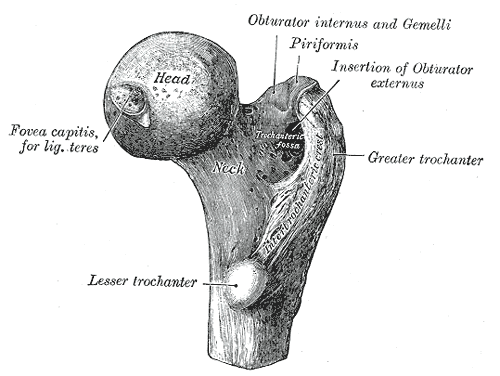
The “ball” or head of the femur bone revolves inside the “socket” of the hip, called the acetabulum. The greater and lesser trochanters are implicated in snapping hip syndrome., as are the iliopectineal eminence (located along the pelvic border along the front of the hip) and the hip capsule (head of the femur in the acetabulum).
Snapping hip occurs when a tendon or ligament rolls over a bony prominence during movement. Depending on where you hear a click, you can determine whether you have internal or external snapping hip.
Types of Snapping Hip
Internal snapping hip is perhaps the more frequent type of snapping hip among ballet dancers due to the amount of emphasis placed on external rotation. Composed of Iliacus and Psoas Major and Minor, the Iliopsoas muscle inserts at the lesser trochanter of the femur and is key in ballet technique because of its ability to lift and rotate the thigh. Dancers with a tight Iliopsoas may experience snapping hip
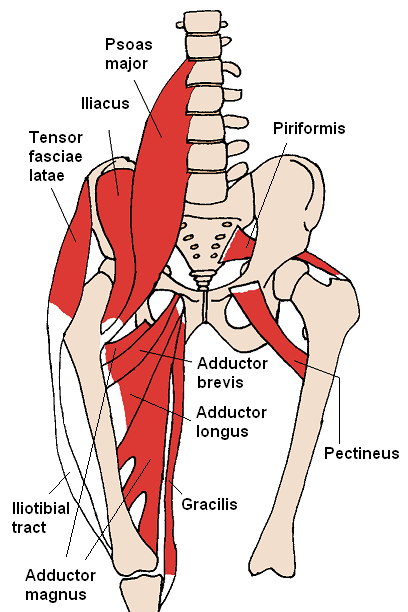
External snapping hip is due to Gluteus Maximus or Iliotibial band (ITB) tightness and snapping in this case occurs as these tendons roll across the greater trochanter of the femur. Flexes and rotates the thigh (of obvious importance to dance). More common overall, but less common among dancers. In this type, you’re likely to experience a click when loading the hip (landing from a jump or sinking into the hip). The snap in this case can sometimes look and feel as though the hip is dislocating. All the more reason to “get up on your leg”, I suppose!
A tight ITB can be problematic and can eventually lead to pain in the hip and knee. One easy way to stretch the ITB is using a foam roller (and if any of you happened to catch February’s Circle Time, then you know how much I love a foam roller).
Lay on your side propped up on one hand with the foam roller just above (but not on) the knee joint and roll toward the hip back and forth.
Make no mistake, this stretch is painful for those with especially tight IT bands, but it’s also one of the most effective ways to stretch the ITB and ease external snapping hip or other associated conditions.
The long and short of those short tendons…
Overall, I want to emphasize that snapping hip is not necessarily a big deal or something to be concerned about. The word “Syndrome” can be deceiving. If you don’t feel pain or aren’t otherwise too annoyed by the click, don’t worry about it too much.
If you do start to develop pain, don’t ignore it. Be sure to see a physician or physical therapist who can treat you and prevent a little pain from turning into something serious like tendinitis or bursitis.
The prevalence of snapping hip in the dance community is an important reminder that dance training alone (especially as concerns ballet technique) may not be enough to build well-balanced strength and musculature.
Dancers experiencing issues with the hips or knees, whether they are experiencing pain or not, might consider the addition of cross-training to their regimen to strengthen muscles such as the abductors and gluteals (muscles that, by the way, support the hip).
Going back to my story about discovering snapping hip in a Pilates class –at the age of 16 I was doing only ballet and wasn’t really encouraged to do anything in the way of cross-training. The continual emphasis on the aesthetically beautiful and high-kick-capable externally rotated hips and legs unequally tone and tighten certain prime movers while leaving others ignored.
Now that I incorporate many types of exercise to my regime in addition to dance, my hips don’t click!
References:
Garry, J.P. (2010). Snapping Hip Syndrome. Medscape Reference. http://emedicine.medscape.com/article/87659-overview
Morgan, V. (2010). Common Lower Extremity Injuries Affecting Female Dancers and a Proposed Screening Tool for Identifying Dancers Prone to Injury, 17-19. http://www.lulu.com/items/volume_67/8564000/8564329/1/print/Dance_Injuries.pdf
Shah, S. (2008). Caring for the dancer: special considerations for the performer and troupe. Current Sports Medicine Reports 7, 128-132.
Do your hips pop? When?
What have you done (if anything) about it?


Lauren Warnecke is a freelance writer and editor, focused on dance and cultural criticism in Chicago and across the Midwest. Lauren is the dance critic for the Chicago Tribune, editor of See Chicago Dance, and founder/editor of Art Intercepts, with bylines in Chicago Magazine, Milwaukee Magazine, St. Louis Magazine and Dance Media publications, among others. Holding degrees in dance and kinesiology, Lauren is an instructor of dance and exercise science at Loyola University Chicago. Read Lauren’s posts.